
Uniformity Flood (Quality Control of gamma camera )
Uniformity Flood
1. الاختبار اللى بيوضح مدى
التجانس فى الصوره بين الPixels حيث
انه بيختبر مدى الvariation
بين الPixels
فى الintensity values
2. ممكن يتم الاختبار فى
وجود الCollimator
ويطلق
عليه extrinsic
او فى عدم وجوده ويطلق عليه intrinsicntrinsic
3.
Intrinsic flood
-يتم ازاله الcollimator من
الhead
of camera
2-يتم استخدام مصدر من ال 99mTC له نشاط اشعاعى اقل من 1mci
3- يتم وضع الِSyringe Activity of
99mTC على مسافه اكبر من 5 FOV للجاما كاميرا
4-لابد ان يكون الcount rate اقل من 20KCPs وده لاجل تلافى تاثير ال Dead time للجاما كاميرا
. 5-لاحظ انك لو شغال على جاما
كاميرا dual
head هاتستخدم مصدر قوته 100-250
uci ويوضع فى المنتصف بين الBoth Head
6-بعض الsystems
تتطلب انك تضع Lead Mask
Lead Mask يوضع حول اEdge لل crystal حتى يمنع
the interaction between crystal edge and gamma rays
Extrinsic Flood
a.
يتم استخدام ال sheet of Co57 او
refillable flood with 5 - 15 mCi
of 99mTc
b.
يتم وضع الflood او ال sheet على ال collimator surface
c.
ولو انا عندى dual head gamma camera
d.
هايتم وضع الflood كما هو موضح بالشكل عن طريق استخدام 4
styrofoam cups من اسفل وواحد من اعلى
للحفاظ على تساوى المسافه بين الcollimators of both head وال flood
Flood
Intrinsic/extrinsic uniformity
1- اولا
لازم تتاكد من الPeak
عن طريق الPhotopeak test
2- ظبط
الacquisition
على
انه يعمل Collection
ل
2-6 Million Counts
3- الFlood لابد ان يكون خالى من اى air bubblesر

Extrinsic Flood
a.
يتم استخدام ال57Co sheet or a refillable flood with 5 - 15 mCi
of 99mTc
b.
يتم وضع الflood او ال sheet على ال collimator surface
c.
ولو انا عندى dual head gamma camera
d.
هايتم وضع الflood كما هو موضح بالشكل عن طريق استخدام 4
styrofoam cups من اسفل وواحد من اعلى
للحفاظ على تساوى المسافه بين الcollimators of both head وال flood
 Flood
Flood 
Intrinsic/extrinsic uniformity
1- اولا
لازم تتاكد من الPeak
عن طريق الPhotopeak test
2- ظبط
الacquisition
على
انه يعمل Collection
ل
2-6 Million Counts
3- الFlood لابد ان يكون خالى من اى air bubbles
e.
Two quantification formulas (you must know)

i.
Integral uniformity evaluates the entire flood at the pixel level and finds the
pixel with the least counts and the one with the most counts.
Apply those numbers to the above formula. This gives you an overall picture on
how uniform the flood is. Over time, if the % slowly increases then service
dude needs to called in for a PM
ii.
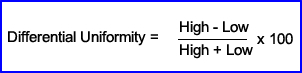
Differential uniformity looks a 5 pixel segment, either vertically or horizontally
and determines what the counts are in each pixel. The one with the most and
less counts are placed into the formula. This value shows non uniformity over a
small segment of the camera
iii.
Integral uniformity will always be greater or equal, but never
less than differential uniformity (why?)
f.
Example I

i.
Both integral and differential calculations are displayed with
FFOV (Full Field of View) and CFOV (Center Field of View)
ii.
To the left is a Levy-Jenning plot where the solid line is the
FFOV and the dotted is CFOV for intergral and differential uniformity over time
iii.
Evaluation of these calculations and graphs, over time, will
determine when the system needs to be re-tuned

g.
Example II - Goal of this system is to find the area of the
greatest non-uniformity
i.
Boxes indicate the area of greatest non uniformity in the UFOV
(Useful Field of View) and CFOV. This generates intergral uniformity for both
views. Is there advantage to not FFOV?
ii.
Boxes can be moved around at the discretion of the user
iii.
The greatest non-uniformity within each box displays a
differential uniformity via the veritical and horizontal line in the UFOV and
CFOV
h.
Additional comments
i.
What are the differences between FFOV, UFOV, and CFOV?
ii.
FFOV cover the entire detector's surface, however, counts tend to
fluxuate at the extreme edges of the FOV which is caused by edge packing. This
may falsely elevate the integral value
iii.
UFOV is 95% of the FOV's area. Notice the outline drawn slightly
inside the edge of the crystal (example II). This removes the edge packing
effect, however, what happens if there is a PMT problem at the edge of the
crystal
iv.
CFOV is 75% of the UFOV
v.
Relationship of integral differential values: FFOV ≥ UFOV ≥ CFOV
vi.
Integral uniformity should be between 1 - 5%. According to NEMA
integral uniformity should be ≤ 5% @ 5 million counts
vii.
For SPECT intrinsic uniformity should be ≤ 3% and extrinsic floods
tend to range a little higher, between 4 - 6%. This may be do to the impurties
of the flood source ajnd/or collimator
ix.
Count profiles can also be drawn by the technologist to further
evaluate pixel variation


Comments
Post a Comment